Heatwave causes person with Parkinson’s to melt

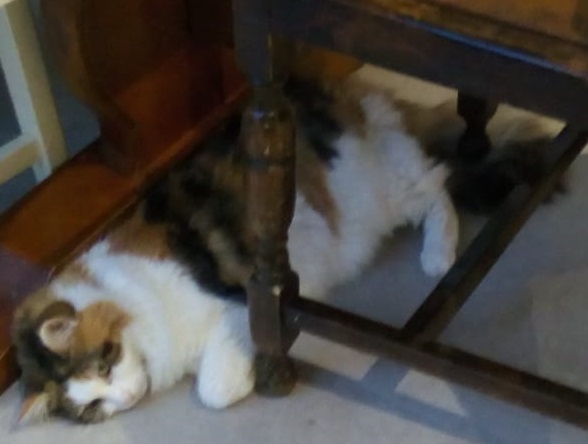
cat knocked out by the heat
Knocked out by the heat

It was 38°C in London this week. On Thursday the result was that I officially melted. Normally I like hot weather, and normally I can operate up to around 32°C, but this week is different. People with Parkinson’s are warned that extreme hot weather may worsen the symptoms. Yet I made several crucial mistakes that are to be avoided: underestimating the heat, going out around midday to pick up something from a friend’s house and to buy a few things in the shops. I had to seek refuge in a Pharmacy that had air conditioning and in the local bakery I had to avail myself of the chance to purchase an ice cream from the newly installed stand.

My walking was up the creek, the tiredness made me sweat and shuffle along. This has persisted for the last few days. My balance is poorer and my slowness is worse. In a Tai chi class this morning I had to sit down because I kept losing my balance. I fear that my symptoms are progressing inexorably – and that is scary – but I must tell myself this is quite probably due to the hot weather. It’s important to carry on so I shall be going out walking this afternoon to pick up a few things for our holiday. I’ll put on my music and hopefully get the rhythm to mark my pace. My Parkinson’s pace.

Laughed at in the street

How would you feel if someone laughs at you in the street, mocking your stiff, tottering steps? Or if they accuse you of being drunk? Apparently, according to a recent survey by Parkinson’s UK reported in The Independent  newspaper, 90% of Parkinson’s sufferers say that they have been harassed in some way the street while 10% claimed to have been openly laughed at.

Such figures are shocking, but, without a way of comparing them with responses from people without Parkinson, difficult to evaluate. Indeed, in many ways the bigger picture with its inevitable broad brush tends to be more clinical than the individual examples of discrimination. It is when those individual cases touch you personally that the real impact is felt.

Twice I have felt that impact acutely. First, when I was shuffling back from a meal in a restaurant where I had not had any alcohol. One of a group of young men emerging from a taxi thought it funny to tell his friends that he hoped to drink as many pints as he thought I must have downed. That is the only time so far that someone has confused my Parkinson’s with drunkenness.

The second occasion I have been laughed at occurred last week. It was late, around 8 PM, and I had to go out to buy some lemons to use in the evening meal. I was tired and my walking was poor so I had to resort to running, alternating with shuffling. I could hear two young boys behind me laughing, one running past me two or three times to look at me. Crossing the main road, I sat down on a bench to rest. The two boys crossed the road after me and looked at me as they passed, one of them mimicking my stiffness in his movement of the shoulders. What should you do in a situation like that? What should I do? Such situations make me nervous rather than angry, but I also think it is important to challenge that behaviour, to make people realise the effect they have and hopefully change in the future.

I called the two boys over and they came. I explained to them that I had Parkinson’s disease, that sometimes my walking was not easy, that I couldn’t avoid these strange stiff movements, that it wasn’t funny and the next time they should remember that. The response was, from the taller one, “I wasn’t laughing at you” and from the other “what’s Parkinson’s disease?” Then the tall one said that his grandparent had Parkinson’s and this seemed to really bring it home to them. I repeated that it wasn’t funny and that they should remember that in the future. They continued their way rather chastened but hopefully they have learned a valuable lesson.
Flying with Parkinson’s disease

I face a difficult conundrum: I’m often invited to speak about translation studies in universities across the globe, but a 12 hour flight is not the most suitable for someone who is suffering from stiffness that gets worse if I remain sitting down for more than half an hour. Add in some anxiety amongst large groups of people (as a rail station or airport for example), plus a conscience plagued by climate change, and you will be able to appreciate that a long-haul flight has its downsides.

A couple of weeks ago I was kindly invited to speak at conferences in Hong Kong and Shanghai. It was a chance to catch up with old friends, meet new people, share my experience and learn from the work they are doing. People are sometimes surprised that I continue to make these trips. But for me they are enriching and, with a little planning, not too onerous. I normally ask for special assistance at the airport, which sometimes means I am pushed in a wheelchair, but, as long as I am not depriving someone else, I’m not too bothered because it means that I have a quick route through security and passport control. It’s there that I need a little help, taking things out of my bag and rearranging them after they’ve passed through the scanner. When I get to the gate I’m allowed to board first.

The employees in the airport are sometimes surprised to see me arrive carrying a rucksack and pulling a small suitcase and at the same time asking for special assistance. That’s the nature of the condition: semi-visible but always nagging. The assistance I receive is very important for me as it reduces the stress of the journey and makes the whole experience much more enjoyable.

I was met at the airport in Hong Kong and Shanghai by a student assigned to look after me. Many thanks to them! I find that on these trips everyone is always so keen to help me and I’m very grateful for it even if sometimes they are unsure exactly what I need. So I’d like to thank everyone who made my stay so enjoyable and rewarding. Just a couple of regrets: my delivery of talks has become more monotonous because of the condition and I need to work on making it more dynamic; to tell the truth, I didn’t help myself by forgetting my watch and being unaware that I had finished my first talk 10 minutes early. The other slight regret was food again. It was all so wonderful, yet I’d convinced myself that I could no longer use chopsticks because of my weakened right hand. Let me state clearly: ‘chopsticks beat knife and fork when it comes to eating Chinese food!’ It was only back home a few days later that I challenged my thinking and decided to take up the sticks again. The result can be seen in the video…