August 5, 2019. We are beside Lake Malawi, an enormous expanse of water that marks Africa’s great Rift Valley. I’m on holiday with my family, staying with the family of friends, wonderful people who run the small, palliative care charity Ndi Moyo. Although I’m here on holiday rather than for treatment, the kindness, attentiveness and practical support of the family reduce my stress and give me time to exercise and relax; the tranquillity of the location creates a perfect environment. I still have work to do for the University, and we try to help the charity’s hospice a little in different ways, but time seems to slow and my symptoms are generally under control.
Ndi Moyo means ‘the place giving life’. It was set up in 2004-5 by the remarkable Lucy Kishindo Finch with the help and support of her husband Tony Finch to provide care for people suffering from painful and incurable illness. Palliative care scarcely existed in Malawi at the time; Lucy, an experienced nurse, had seen just how bad the situation was at one hospital where all the pain relief they could offer one dying man was aspirin. Today Ndi Moyo has a local staff of 20 and provides treatment and help to patients and training to nurses throughout the area of Salima, where I am told there are only two fully qualified doctors for a population of 500,000. The charity does amazing work in difficult circumstances and is dependent on donations and gifts to fund its work. Please check out their website (ndimoyo.org) and give as generously as you can.
Relatively low incidence of Parkinson’s is reported in Malawi and surrounding countries. However, the number of cases is likely to be much higher because many people are unable to consult a doctor or they are possibly suffering from a more serious condition so the Parkinson’s remains undetected. Such contrasts put into perspective the complaints we level against our own medical services. For instance, can I with good conscience protest at having to wait 12 months for my next consultation with the neurologist when the entire population of Malawi (18,000,000) apparently depends on one neurologist and only a minority of Malawians can actually afford treatment? Of course, we should all demand a high level of attention; it’s just that in Malawi, and despite the good cheer of its people, such problems are of a different scale altogether.
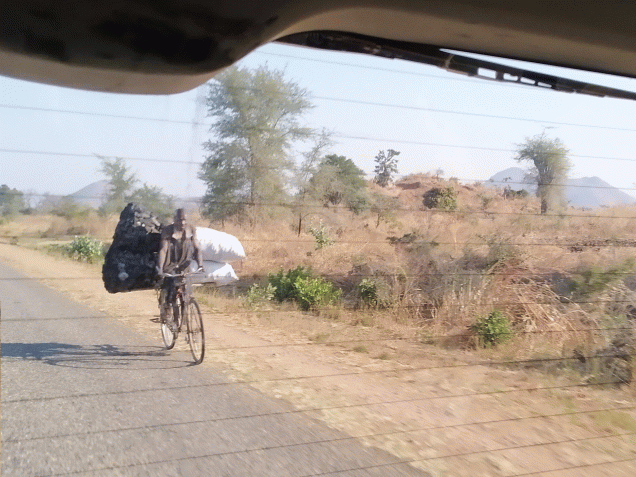
So where do the title’s 80 kg of charcoal come from? One thing that has impacted me most are the roads. A few main roads are asphalted, and these are made even more striking by the never-ending procession of people on both sides of the road walking long distances in ones, twos or threes. And bicycles, often with a passenger, risking life and limb whenever a car or truck passes. A good number of these people are carrying something. Sometimes a basket of washing, sometimes a bowl of vegetables or a bundle of wood or even a baby. Sometimes the load is heavier and involves serious intervention in the natural environment: bags of charcoal, used for cooking but the product of cutting and burning that add a worrying haze to the landscape, are sold by the side of the road. The photo shows a cyclist transporting two bags, probably amounting to 80 kg. He is beginning a long upward slope. A hard slog. He keeps going, as he always does, fighting the odds but carrying a heavy burden. It is that thought that will resound for me back in London when I’m struggling uphill, working my exercise bike or simply walking along a pavement.
More from Malawi soon…
 parkinsonSpace