It’s a very long time since I posted here. Lots of things have happened. I officially retired in October 2022, but am remaining active. My Parkinson’s is generally under control, and I’ll try and write more about that soon.
Thank you to all who have been in touch. I’ll try and respond. Thanks for your patience.
It’s a long time since I’ve written this blog. A lot has happened. And I have spent a lot of time indoors during the Covid crisis. Things have been difficult, but hopefully they’re getting better now. I want to bring you up to date on what’s been happening with my Parkinson’s and begin to catch up with old and new friends alike. So, please bear with me. I’m hoping to post blogs quite frequently in the next few weeks on many different subjects which have been preoccupying me over the last months. See you again soon.
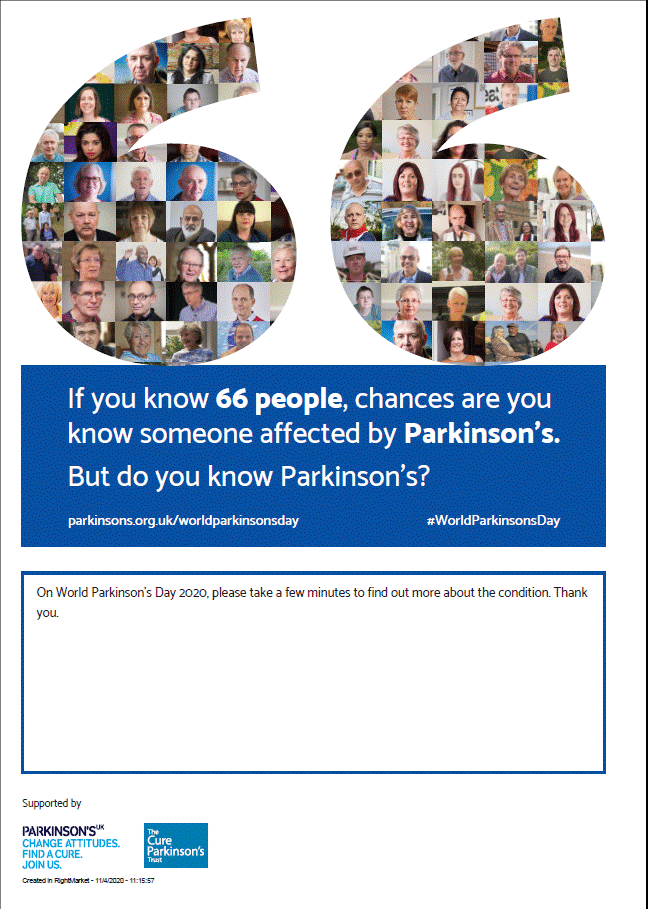
Today, Saturday 11 April, is World Parkinson’s Day. Although many of the planned events have been cancelled because of COVID-19, the day and the week are still being used to raise awareness about Parkinson’s.
For more details in the United Kingdom, see the website of Parkinsons.org.uk . Click here for the precise page.
One of the features is an interactive map containing stories of many people who live with Parkinson’s.
If I were to highlight one feature of my Parkinson’s that I would like people to know, it would be that I just need a little more time to adjust to things and to plan any activity. This may be frustrating for me and for you, and sometimes things go wrong. By all means ask if I need help (I will accept if I need it) but don’t assume I can’t do a task. Be patient; I will usually get there in the end.
As a person with Parkinson’s disease, I know how important it is to exercise. During the current lockdown in London because of the COVID-19 virus, I’m trying to follow a daily routine of five basic exercises as championed by the Royal Canadian Air Force in the 1950s. I hope the video gives you an idea of what it is. Apologies for the poor audio quality.
It’s March 21 and Spring has officially arrived. What a strange feeling. Nature is beginning to come alive again, leaves are appearing along with blossom on the pear tree.
But we are at the beginning of a huge health crisis. London is quiet as many of the shops are shut or empty and most people are indoors. I have been working from home and today is the first day I have ventured out during the past week. The news has become ever more serious; the numbers of people infected and dying increase each day.
Last week I wrote about pessimism and the difficulties of the
last few months. This week on some days I have been absolutely euphoric. My
walking has sometimes been excellent, as it used to be before I was diagnosed. That
feeling comes a few times a month, now more frequently than it used to. It
comes when I start walking and feel a lightness in my legs, pushing off with the
foot and striding out along the pavement.
I haven’t really written much in the blog recently. The last post was at the end of September, just before teaching began, when I left a video for my students to explain the symptoms of Parkinson’s. Over the last few months, I’ve had some ups and downs – more downs than ups, I think sometimes. I certainly haven’t managed to produce posts as frequently as I had before the summer, so in the near future I would like to talk more about specific events such as the holiday in Malawi, the return to work, voice therapy and physiotherapy, amongst others. These are all Good Things. However, today I want to focus on the downs of Parkinson’s.
August 5, 2019. We are beside Lake Malawi, an enormous expanse of water that marks Africa’s great Rift Valley. I’m on holiday with my family, staying with the family of friends, wonderful people who run the small, palliative care charity Ndi Moyo. Although I’m here on holiday rather than for treatment, the kindness, attentiveness and practical support of the family reduce my stress and give me time to exercise and relax; the tranquillity of the location creates a perfect environment. I still have work to do for the University, and we try to help the charity’s hospice a little in different ways, but time seems to slow and my symptoms are generally under control.
Ndi Moyo means ‘the place giving life’. It was set up in 2004-5 by the remarkable Lucy Kishindo Finch with the help and support of her husband Tony Finch to provide care for people suffering from painful and incurable illness. Palliative care scarcely existed in Malawi at the time; Lucy, an experienced nurse, had seen just how bad the situation was at one hospital where all the pain relief they could offer one dying man was aspirin. Today Ndi Moyo has a local staff of 20 and provides treatment and help to patients and training to nurses throughout the area of Salima, where I am told there are only two fully qualified doctors for a population of 500,000. The charity does amazing work in difficult circumstances and is dependent on donations and gifts to fund its work. Please check out their website (ndimoyo.org) and give as generously as you can.
Relatively low incidence of Parkinson’s is reported in Malawi
and surrounding countries. However, the number of cases is likely to be much
higher because many people are unable to consult a doctor or they are possibly
suffering from a more serious condition so the Parkinson’s remains undetected. Such
contrasts put into perspective the complaints we level against our own medical
services. For instance, can I with good conscience protest at having to wait 12
months for my next consultation with the neurologist when the entire population
of Malawi (18,000,000) apparently depends on one neurologist and only a
minority of Malawians can actually afford treatment? Of course, we should all demand
a high level of attention; it’s just that in Malawi, and despite the good cheer
of its people, such problems are of a different scale altogether.
So where do the title’s 80 kg of charcoal come from? One
thing that has impacted me most are the roads. A few main roads are asphalted,
and these are made even more striking by the never-ending procession of people on
both sides of the road walking long distances in ones, twos or threes. And
bicycles, often with a passenger, risking life and limb whenever a car or truck
passes. A good number of these people are carrying something. Sometimes a
basket of washing, sometimes a bowl of vegetables or a bundle of wood or even a
baby. Sometimes the load is heavier and involves serious intervention in the
natural environment: bags of charcoal, used for cooking but the product of cutting
and burning that add a worrying haze to the landscape, are sold by the side of
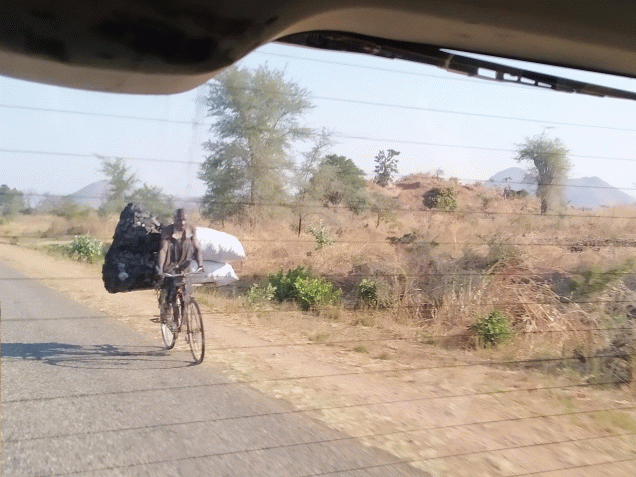
the road. The photo shows a cyclist transporting two bags, probably amounting
to 80 kg. He is beginning a long upward slope. A hard slog. He keeps going, as
he always does, fighting the odds but carrying a heavy burden. It is that
thought that will resound for me back in London when I’m struggling uphill, working
my exercise bike or simply walking along a pavement.
 parkinsonSpace